Flashcard Apps for Studying When You Only Get 20 Minutes a Day
You booked the certification exam and get twenty minutes a night. How to stop re-reviewing what your job already taught you and drill only the real gaps.
10 min read
The exam is booked. The money is spent. The date is sitting in your calendar somewhere between a sprint review and your kid’s dentist appointment, and every time you look at it, it feels a little closer than it did yesterday.
So you do the responsible thing. You go looking at flashcard apps for studying, grab a deck someone else made, and give it twenty minutes after dinner. It feels productive. You’re getting most of them right.
That’s usually the problem.
If you work in the field you’re getting certified in, a big chunk of any general-purpose deck is stuff you already do at your desk. The cards you breeze through aren’t teaching you anything — they’re just pleasant. Meanwhile the topics you’ve genuinely never touched, the ones the exam blueprint weights heavily and your job has never once required, keep sliding past because they’re uncomfortable and there are only twenty minutes.
This post is about fixing that mismatch. Not by finding more time — you don’t have more time — but by making sure the twenty minutes you do have land on material that’s actually at risk.
The short answer
If you’re studying for a certification around a full-time job, twenty minutes a day is enough — but only if those minutes skip what your job already taught you. Audit your knowledge against the published exam blueprint first, drill only the gaps using active recall (type or say the answer, don’t pick it from four options), let a spaced repetition schedule decide the order, and measure your pace against your exam date rather than against hours logged.
Why most flashcard apps for studying waste your best twenty minutes
There’s a well-documented gap between recognizing an answer and producing one. Read a definition, nod along, feel the click of familiarity — that’s recognition. Being asked a cold question and having to generate the answer from nothing is production, and it’s what researchers mean by active recall. Exams test the second one. Most casual review only exercises the first.
Two things make this worse for working professionals specifically:
- Your daily work rehearses a narrow slice. If you spend all day in one cloud service, one framework, or one clinical area, that slice is already deeply learned. Re-reviewing it is close to free, which is exactly why it feels good.
- Pre-made decks are averaged for strangers. A deck built for “everyone taking this exam” has no idea which third of it you could pass in your sleep.
Put those together and you get the classic outcome: hours logged, confidence high, score report full of surprises.
The overlap trap: your job covers part of the exam, just not the part you think
Almost every certification is broader than any single job.
- An AWS Solutions Architect candidate who lives in EC2 and S3 all week still has to answer on Direct Connect, Organizations SCPs, and migration services they’ve never had a reason to configure.
- A PMP candidate who ships projects competently every day gets asked about process groups their company replaced with an internal workflow years ago.
- A CISSP candidate running the actual security tooling faces a heavily weighted legal, risk, and governance domain that rarely touches the day job.
- An experienced nurse sitting NCLEX knows their unit cold and still has to cover pharmacology and specialties they haven’t worked since clinicals.
Your experience buys you real advantages — you understand why things work, so concepts stick faster once you meet them. What it doesn’t buy you is coverage. And the exam doesn’t care that the topics you missed happen to be the ones nobody at your company handles.
The useful move, then, isn’t studying harder. It’s finding the seam between what the job taught you and what the blueprint tests, and pointing every available minute at that seam.
Five ways to make twenty minutes actually count
1. Audit before you study, not after
Before you touch a card, spend one session writing out what you already know about each exam domain. Plain sentences, from memory, no notes open. It’ll feel like a waste of a study night. It isn’t.
What you produce is a map. Topics where you wrote three confident paragraphs are done — leave them alone. Topics where you wrote “uh, something about key rotation?” are your entire study plan for the next few weeks. That distinction is worth more than any deck you can download.
2. Let the blueprint set the priorities
Every certification body publishes a domain breakdown with percentage weights. It’s usually a boring PDF nobody opens. Open it.
Cross-reference it against your audit and you’ll typically find two or three domains carrying serious exam weight where your honest self-assessment was thin. That’s the list. Everything else is optional until that list is handled.
3. Write the answer, don’t recognize it
Multiple choice is convenient and it flatters you. When you’re short on time, favor formats that force production:
- Fill-in-the-blank (cloze) — one key term removed from a real sentence.
- Free recall — a question with a blank box, where you type the answer before seeing anything.
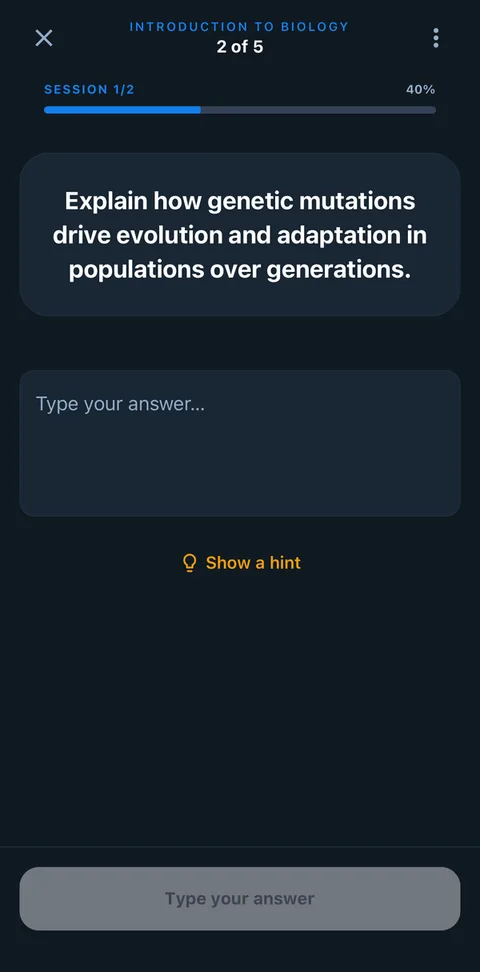
You’ll get more wrong. That’s the point; the misses are the signal you’re paying for. Fifteen honest free-recall questions tell you more about your readiness than sixty comfortable multiple-choice ones.
4. Stop deciding what to review
Deciding what to study burns real minutes and you’ll decide badly — humans reliably pick the pleasant material. Spaced repetition exists to take the decision away: the app resurfaces each item right before you’d forget it, stretching the gap every time you get it right and shrinking it when you don’t.
Good digital flashcards handle this invisibly. You open the app, answer what’s in front of you, and close it. No planning required.
5. Work backwards from the date, not forwards from today
“I’ll study when I can” has no failure signal until the week before. A date-anchored plan does: if you have forty untouched concepts and eighteen days, you need a bit over two new ones a day, every day. Miss a week and the number moves.
Seeing that number is what turns a vague sense of dread into a decision — study fifteen extra minutes on Saturday, or move the exam. Both are fine. Not knowing which one you need is not.
What this looks like on an actual Tuesday
You get home at 7:40. Dinner, dishes, the kid’s finally down. It’s 9:15 and you have until roughly 9:35 before you stop being useful.
The old twenty minutes: open a 900-card deck, answer whatever it shows you, get 85% right, feel fine, close the app.
The new twenty minutes: open the app to eleven questions. Nine of them are from the three domains your audit flagged as weak. Two are older gaps coming back around because the schedule says you’re about to forget them. You type real answers, get four wrong, read why, and see that you’re on pace for the 4th. Close the app.
Same twenty minutes. Wildly different exam.
What to look for in flashcard apps for studying on a deadline
Running the five steps above by hand is entirely possible — plenty of people do it with a spreadsheet and a deck they built themselves. It’s just a lot of admin for someone with twenty minutes a day. If you’d rather a tool carried it, these are the features that actually matter:
- It reads your material. You already bought the official study guide. An app that turns your own PDF, slides, or photographed notes into questions beats any generic deck, because it’s scoped to your exam.
- It asks what you already know, first. Without that step, every app is guessing at your gaps.
- It makes you produce answers. Cloze and typed free recall, not endless multiple choice.
- It schedules for you. Spaced repetition running quietly in the background, no manual deck management.
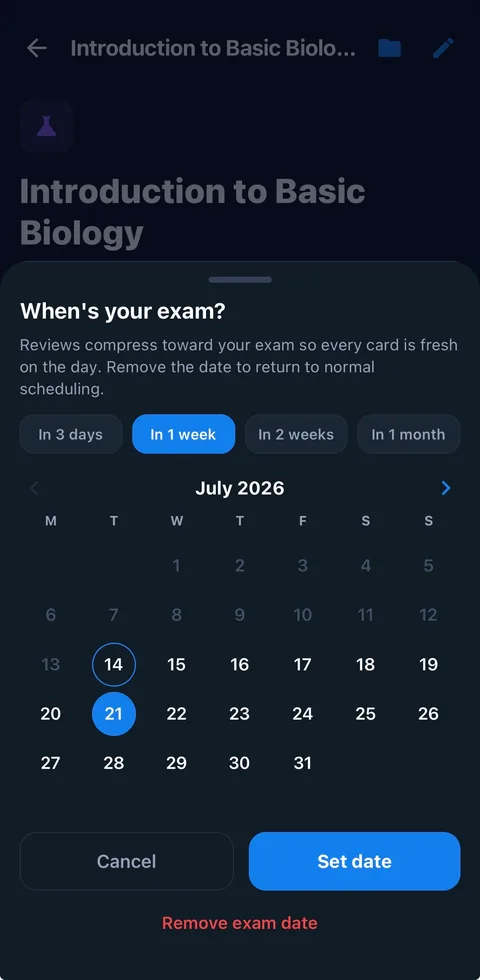
- It knows your exam date. Reviews scheduled after your test date are wasted, and “am I on pace?” should be a number you can see.
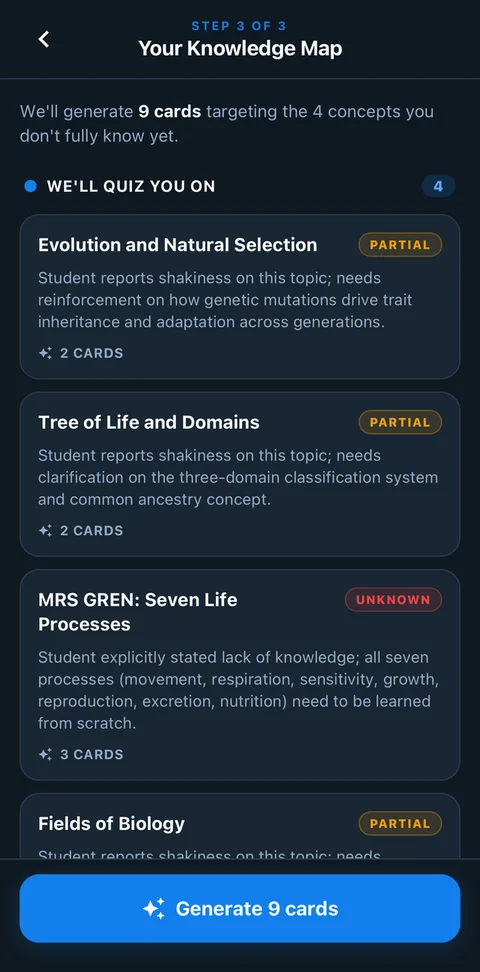
That list is more or less the spec Recallity was built against. You upload the material you already have and it reads it. Then, instead of generating a card for every sentence, it asks what you already know about the topics inside — you answer in plain language, the way you’d explain it to a coworker.
From that it builds a map of where you’re solid, shaky, and empty, and generates recall cards for the shaky and empty parts. Add your exam date and it keeps a running read on whether you’re on track or behind, tightening the schedule as the date approaches so nothing is queued to return after the test. If a card ever looks wrong, you can tap through to the passage in your own material it came from. It’s built for exactly this kind of deadline studying, and there’s more detail on the flow in the FAQ.
It won’t make the exam easy. It mostly just makes sure your twenty minutes never get spent on the parts you use at work every day.
The short version
You don’t have a time problem. You have a targeting problem — and the two feel identical right up until the score report.
- Recognition isn’t recall. If it feels easy, it probably isn’t teaching you anything.
- Your job covers part of the exam, and rarely the part you’d guess. Audit honestly before you study.
- Weight your effort by the published blueprint, not by what’s interesting.
- Prefer formats that make you produce the answer from memory.
- Anchor everything to the date you already paid for, so “behind” becomes a number instead of a feeling.
Do that, and twenty minutes a night is genuinely enough for most professional certifications. It’s not about grinding more cards — it’s about only ever seeing the ones that can still surprise you.
If you want to see what your own gap map looks like, Recallity is free to start on the App Store — bring the study guide you already bought.